Journey into Maths Country (2021)
Math is an exotic and confusing country. We speak a bizarre language, full of homeomorphisms, differential varieties, transfinite numbers. But we also find epic landscapes, dizzying ideas and even, sometimes, useful things!
📺 Seasons & Episodes
Season 110 episodes
1. Benford’s Law
⏱ 10 minFrank Benford observed that the number one seems to pop up a lot in both in the supermarket and on tax bills. In understanding this law, it helps to simply look at the world from a different perspective.

2. Newton and the Infinitesimal Calculation
⏱ 10 minSpeed is such a common term that it's easy to forget how much of a role maths plays in understanding it. Until three or four centuries ago, there was no speed at all. It was only since the Renaissance that the concept of movement crept into the world of mathematics, thanks to calculus and Isaac Newton.
3. To Infinity, and Beyond
⏱ 10 minA circle is also a triangle and a triangle is a square. Sound impossible? Not in the realm of topology, which even applies to 3-dimensional spaces and anything from donuts, UFOs and potatoes. The discipline's inventor, Henri Poincaré, created one of the most difficult problems in mathematics.

4. On the Road to Infinity
⏱ 10 minIn this episode of our travels in the land of maths, we are heading towards Infinity. And even beyond, because infinity comes in many sizes. That may seem strange, but Georg Kantor and his set theory will help us come to terms with this maths concept of dizzying scale.
5. Gödel’s Theorem
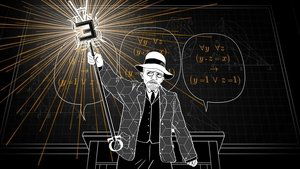
⏱ 10 minIn this episode, we look at the relationship between maths and truth. Maths is meant to be certain, either right or wrong. Turns out, it’s not that simple. For Gödel's theorem has proved that there are “undecidable” theories, which one can neither prove nor disprove.
6. The Prisoner’s Dilemma
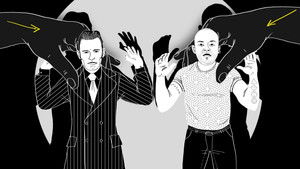
⏱ 10 minTwo prisoners must choose between cooperation and betrayal without consulting each other. This famous prisoner's dilemma that will take us to the heart of game theory. We think mathematically about a very philosophical question: is it in our interest to collaborate with others?
7. The Game of Life
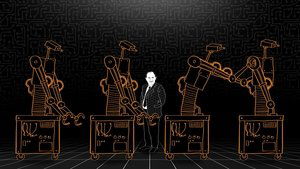
⏱ 10 minIn October 1970 Scientific American magazine introduced a game under the heading “Mathematical Games” that quickly became a cult classic. The idea behind John Conway’s “Game of Life” is cellular automaton. The game’s creator hoped to help with the understanding, simulating or even recreation of life itself.
8. Irrationality
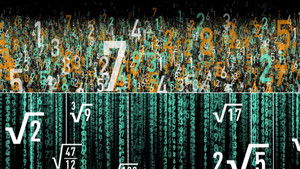
⏱ 10 min25 centuries ago, the well-ordered world of natural integers and fractions had to expand to accommodate monsters like π and √2. It's a dizzying mathematical expedition where we will realise that real life numbers are only the tip of the iceberg.
9. A Complex Picnic
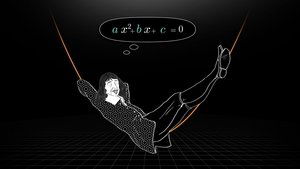
⏱ 10 minWe have known for a long time that some equations can't be solved as the answers are numbers that don't exist. Fortunately, a slew of mathematicians have uncovered a new field of numbers that now play a vital role in modern mathematics.

10. The Riemann Hypopthesis
⏱ 10 minEnd of the trips in the land of math with an arduous hike. It is better to be strong on the complex plane. Because it is about an unsolved mystery of mathematics, namely: the distribution of prime numbers. Riemann made a hypothesis considered as valid but still not proven, that is to say that it is not a walk in the park. Let's go slowly...
Season 210 episodes
1. The Monty Hall Problem
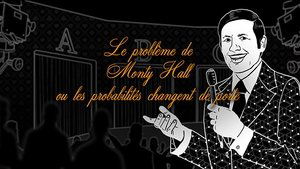
⏱ 10 minThe Monty Hall paradox, named after a game show from the 60s, concerns the way in which information acquired during the course of a game modifies (or not) the winning statistics. Theoretically solved, the question is so disturbing to our worldview that it continues to be the subject of passionate debate to this day.

2. Simpson's Paradox
⏱ 10 minStatistics seem, almost by their very nature, to convey a positivist message. They are, in fact, a formidable tool in the attempt to master the complexity of the real world... But numerous "biases" threaten any discourse that refers to them without care: an over-simplistic reading of the figures can lead us - for example - to confuse correlation with causation... And more complex phenomena (notably Simpson's paradox) can distort conclusions that seem objective.
3. Non-Euclidean Geometries
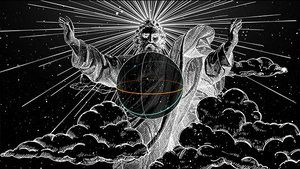
⏱ 10 minFor centuries, geometry was based on Euclid's postulates, which seemed eternal and irrevocable. However, one of the postulates (the fifth) has always seemed "a little less natural" than the others, and hundreds of mathematicians have tried in vain to do without it by deducing it from the other postulates. In the mid-19th century, Bernhard Riemann came up with a novel idea: let's imagine it's false! This was the birth of "non-Euclidean geometries", which would later have major applications in physics.
4. Planar Tessellations
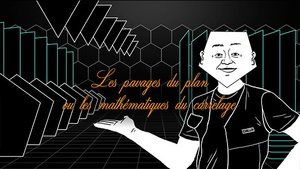
⏱ 10 minA tessellation is a way of covering a plane with a repeating pattern... Basically, it's like creating wallpaper. In 1975, Marjorie Rice (1923- 2017), a mother and amateur mathematician, read an article by Martin Gardner in Scientific American that listed ALL possible "pentagonal tessellations" in the plane. A mathematician had just proved that the list was complete. Except that Marjorie, working alone at home, found 4 new ones... The theorem was wrong!
5. Graph Theory
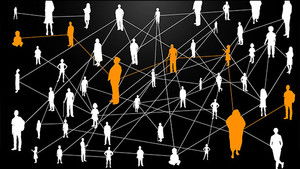
⏱ 10 minThe question is how to make a network that is both "economical" and "robust" without taking up too much space. This is a theoretical question worked on by the great Russian mathematician Andrey Kolmogorov (1903-1987). But this theoretical question also conditions the way in which we can build a computer network or... a human brain: to be intelligent without having a big head, you need a neural network that is efficient BUT ALSO compact! Mention Szemeredi lemma?
6. Alicia Boole in the Land of Polytopes
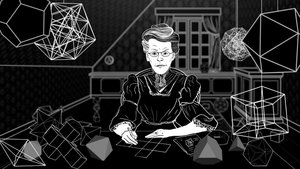
⏱ 10 minTo begin with, there are the five "Platonic solids" beloved of geometers: the cube, the tetrahedron, the octahedron, the dodecahedron and the icosahedron. But why stop at the 3 dimensions of ordinary space? Alicia Boole Stott has devoted her life to finding regular solids in dimension 4... and she's found them! A journey into unsuspected mathematical regions.
7. The Kepler Conjecture, or How to Store Your Cannonballs
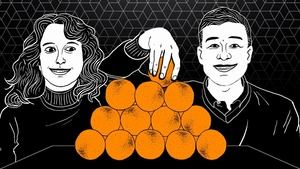
⏱ 10 minWhen mathematics tells us the best way to stack oranges... Formulated in 1611, Kepler's conjecture was finally proved by Thomas Hales... in 1998! Using computational methods unorthodox for his colleagues. The certification of mathematical demonstrations is an arduous and tedious process.
8. Chaos Theory or Order in Disorder
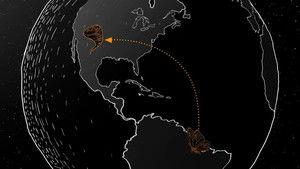
⏱ 10 minCan the flap of a butterfly's wings in Brazil trigger a tornado in Texas? Behind Edward Lorenz's all-too-famous question lies a mathematical theory of things we'd never imagined before belonged to the land of maths: complex systems like those that describe the weather, or even... human affairs!
9. Kovaleskaya's Spinning Top or The Best Way to Spin
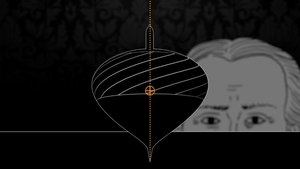
⏱ 10 minHow do you model the movement of a potato in space? Many a mathematician has struggled with this question. At the end of the 19th century, mathematician Sofia Kovalevskaya finally obtained an important result for determining the motion of a solid around a fixed point, thanks to a very special spinning top. A little expedition to the heart of integrable systems, even if it's a bit dizzying...
10. Entscheidungsproblem: The End of Mathematics?
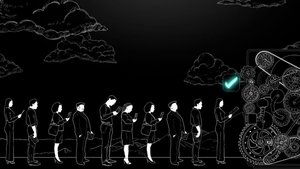
⏱ 10 minImagine a world where a machine could calculate true and false... Failing that, Church, Herbrand, Gödel and Turing each tried in their own way to determine whether an algorithm could decide whether or not a mathematical assertion could be proved. The Entscheidungsproblem, the decision problem that rocked maths and, in the process, laid the foundations of computer science.